CURATORIAL PROPOSAL: SERBIAN-HUNGARIAN DIALOGUES
Festival: Danube Dialogues 2026 (Dunavski dijalozi)
Overall Festival Theme: Rituals and Rhythms (Curated by Ksenija Marinković)
Project Segment: Curated Bilateral Exhibition Series (Serbia — Hungary)
Location: Novi Sad, Serbia (four urban venues)
Segment Curator: Stevan Vuković
Context of the Festival and the Segment:
The Danube Dialogues Festival has operated continuously since 2013 as a dedicated platform for international artistic exchange and cooperation in the Danube macro-region, with its extensive archive and past editions documented on the official website: http://danubeartfest.org/. Rooted in the „Art Without Borders” program developed by the Bel Art Gallery, the festival builds on geographical, historical, and cultural ties, as well as the strong presence of regional minority communities. In its regular editions, the festival features dedicated bilateral segments—having previously hosted successful artistic dialogues with Austria, Montenegro, Slovakia, and Romania (specifically through multi-year collaborations with Timișoara during the European Capital of Culture preparations).
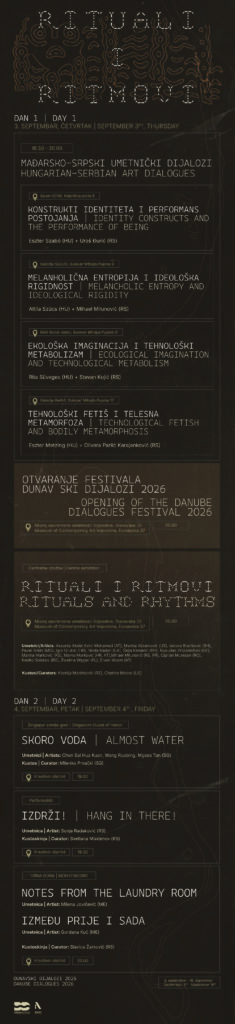
For the 2026 edition, scheduled for September, the overall festival theme has been established by chief curator Ksenija Marinković as „Rituals and Rhythms.” As a response to this overarching framework, this specific Serbian-Hungarian bilateral segment is structured around four individual, simultaneous exhibitions pairing one artist from Hungary and one from Serbia. The selection of these specific artists serves as a curated critical investigation that maps onto Marinković’s overarching concept, examining how contemporary art practices from both scenes articulate, disrupt, or synchronize with the shifting structural frequencies of our everyday realities.
Conceptual Framework for the Bilateral Dialogues:
In alignment with the festival’s main theme, this segment maps contemporary art production from Serbia and Hungary across four distinct spatial nodes, positioning it as a site of continuous renegotiation between the subject and the surrounding structural systems. Grounded in the tradition of Henri Lefebvre’s Rhythmanalysis, this exhibition framework examines the complex interplays of eurythmy and arrhythmia within our existence: from melancholic silences and ideological constructs to identity-driven friction, ecocritical activism, and post-human bodily metamorphoses. The segment’s four nodes function as a liminal curatorial journey responding to the festival’s core premise—a transitional space where the artistic act, whether destructive, repetitive, or transformative, becomes a formal ritual. This ritual serves to decode, resist, and realign with a world that constantly alters its own frequency, offering alternative models of sensory and critical navigation.
Segment 1: Melancholic Entropy and Ideological Rigidity
Venue: SULUV Gallery (Association of Visual Artists of Vojvodina)
Venue Website: https://suluv.org/
Artists: Attila Szűcs (HU) / Mihael Milunović (RS)
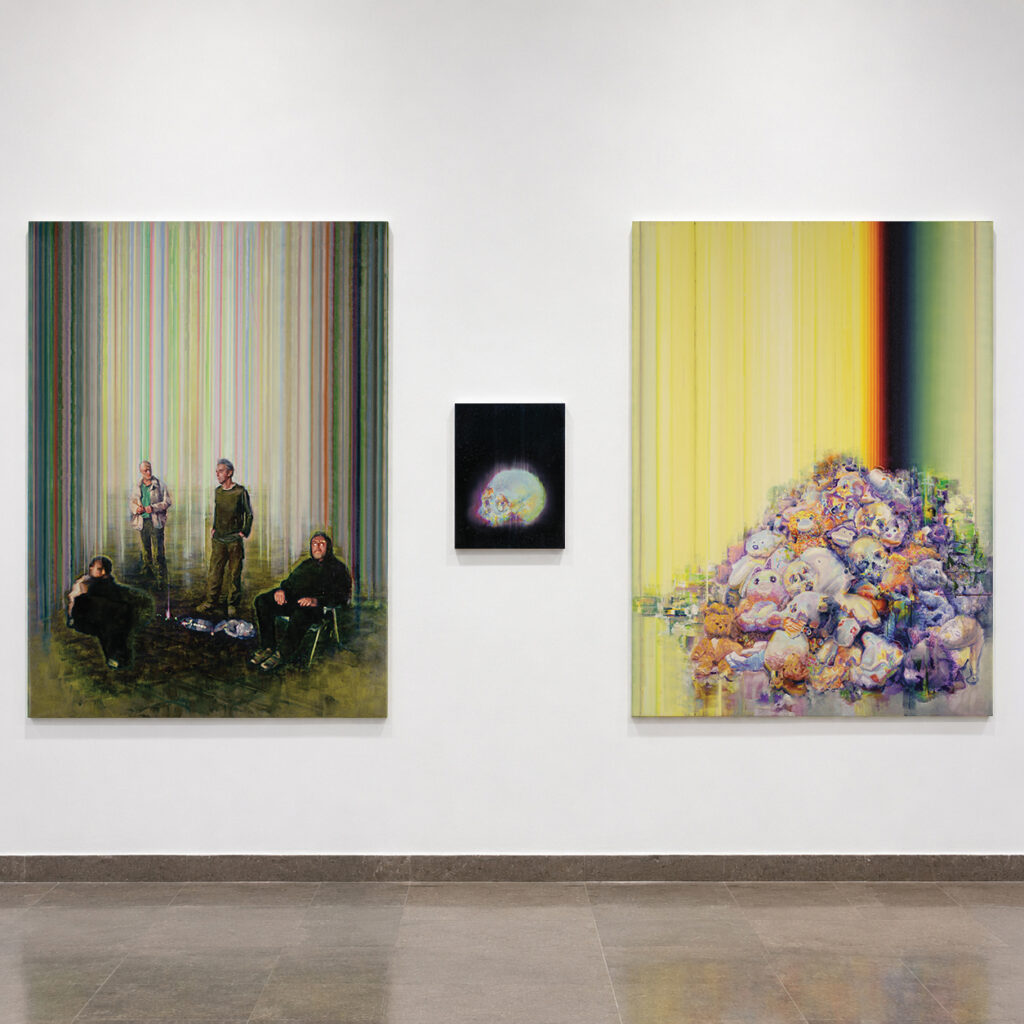
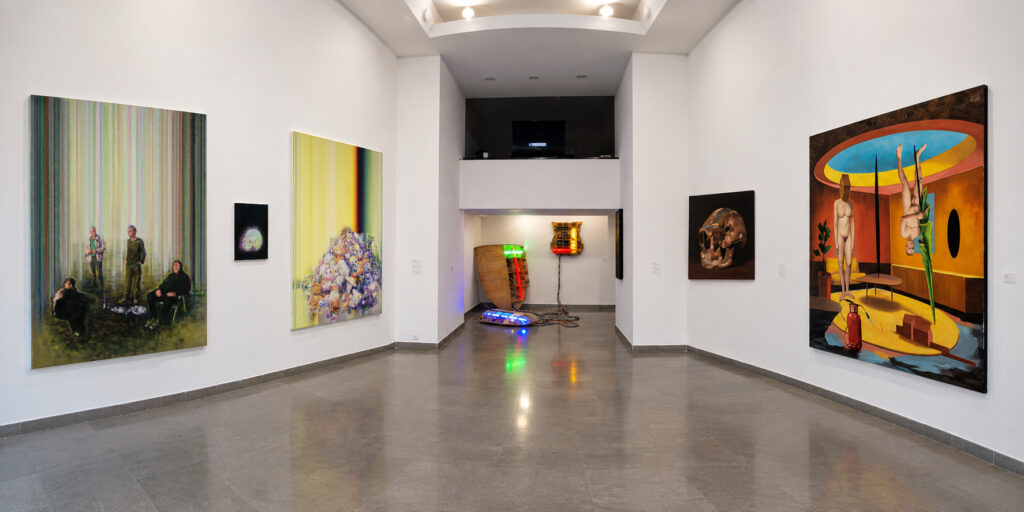
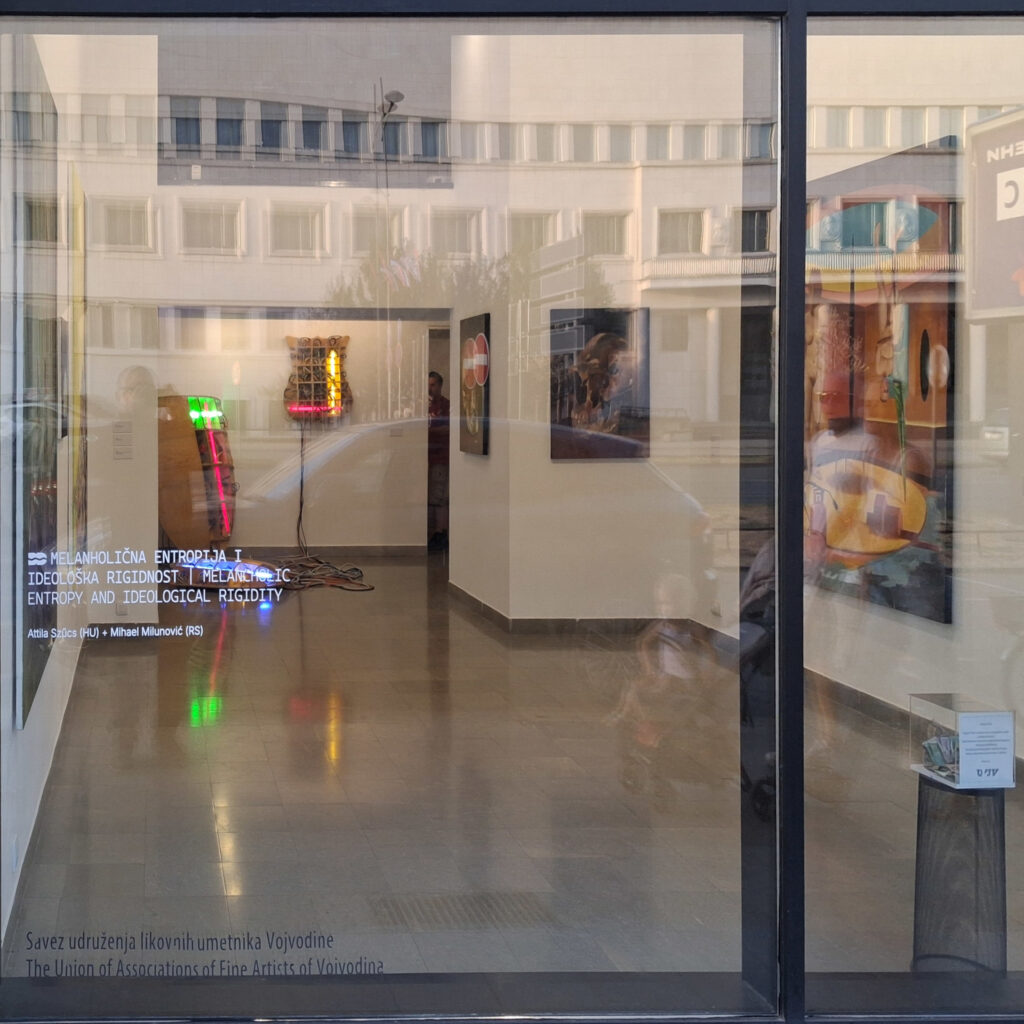
In the dialogical encounter between Szűcs and Milunović, the festival’s thematic axis of „rituals and rhythms” is decoded as a constant oscillation between internal entropy and external discipline. Szűcs’s visual fields operate as an oneiric ritual of silence; he paints „vacuum states” in which the human figure dissolves, losing stable spatial coordinates under the influence of chromatic noise and fractured collective memory. Conversely, Milunović delivers public rituals, dictated by the rhythm of authoritative iconography, heraldic codes, and ideological signifiers. His figures undergo systematic painterly distortions: faces are defaced, faceted, or erased altogether; bodies are reduced to faceless ciphers marching in formation. His spaces are flattened into administrative testing grounds, while the heraldic contents turned into simulacra, exposing the signifier as an empty, self-reproducing apparatus of oppression.
Curatorial Argument:
This pairing places the viewer on a conceptual seesaw between two extremes: a private world fading into oblivion and internal entropy (Szűcs), and a public sphere that surveils, frames, and formats us through its over-emphasized symbolization (Milunović). Where Szűcs’s figures dissolve into painterly entropy, Milunović’s subjects are aggressively deformed. Yet these deformations are not signs of successful assimilation but of its failure: the symbolic order cannot fully capture the subject, and the unsymbolizable excess that escapes erupts through the cracks of ideological representation, leaving behind appearance-affected bodies as witnesses to that failed incorporation.
Segment 2: Identity Constructs and the Performance of Being
Venue: Salon KCNS (Cultural Center of Novi Sad)
Venue Website: https://www.kcns.org.rs/
Artists: Eszter Szabó (HU) / Uroš Đurić (RS)
Within the space of the SULUV Gallery the ritual of self‑representation becomes a battleground between mythic stability and processual fragility, treating identity as a repetitive, highly stylised performance.
Drawing from his Populist Project, Đurić acts as a strategist of identity who appropriates distinctly modern visual codes—Malevich’s post‑suprematist figuration, constructivist geometry, and the glossy iconography of contemporary sports and celebrity media. He transposes these readymade elements into painterly form, reworking their borrowed authority across the canvas through layered compositions and deliberate stylistic quotations. By appropriating the compositional authority of historical avant‑garde painting alongside the visual grammar of mass circulation, he turns his own portrait into a conceptual device that probes the mechanics of popular representation. Inserting himself into the lineage of iconic figuration and tabloid imagery alike, he does not celebrate heroic agency but parodies its very structure. His self‑portraits become a means of exposing identity not as an authentic core, but as a product of pictorial convention and ideological projection.
Facing this self‑reflexive, critically distanced rhythm, Szabó, in works such as her Cranach Woman series, performs a painterly and curatorial deconstruction of that very same historical heritage. She shifts the focus from the iconic hero to the micropolitics of the exhausted body. Her canvases capture the micro‑movements of fatigue and resignation, the slippages of domestic routine, and the quiet rituals of everyday alienation. Rather than appropriating powerful visual languages to expose their ideological structures, Szabó inhabits their undersides, where the body’s vulnerability and the texture of ordinary life resist grand narratives through an aesthetics of imperfection and decay.
Curatorial Argument:
A collision of two distinct critical strategies—Đurić’s painterly appropriation, which drains heroic and media‑driven codes of their authority by reworking them through quotation and painterly transcription, and Szabó’s haptic, painterly excavation, which dwells within the cracks of historical representation to recover the somatic and the desublimated. Where Đurić operates through spectacular mimicry and ironic self‑insertion, laying bare the constructedness of public identity, Szabó works through intimate embodiment and the poetics of failure, rendering visible what official imagery systematically erases. Both artists refuse the given frameworks of artistic authority, yet they pursue this refusal through opposite registers: Đurić by exploiting the very logic of pictorial convention and media spectacle to expose their empty mechanics, Szabó by turning away from spectacle altogether and grounding her practice in the vulnerable, repetitive textures of everyday life.
Segment 3: Ecological Imagination and Technological Metabolism
Venue: Mali likovni salon (MLS)
Venue Website: https://www.kcns.org.rs/ (Official subset of KCNS Gallery spaces)
Artists: Rita Süveges (HU) / Stevan Kojić (RS)
An absolute hybrid ecosystem is established within the Mali likovni salon (MLS), where technological hardware directly intertwines with political ecology. Kojić develops a ritual of care and techno-symbiosis; he creates bio-machines and self-sustaining habitats that serve as life-support prosthetics for plant matter, translating their organic pulse and sensor data into real-time electronic frequencies. Süveges conducts a ritual of intellectual deconstruction rooted in ecocritical methodology (associated with projects like the xtro realm). Through the visualization of industrialized and mechanized landscapes of the Anthropocene, she exposes how techno-capitalist narratives actively shape, limit, or disrupt our capacity to imagine an ecological future.
Curatorial Argument:
An encounter between practical bio-ethics and critical imagination. SULUV becomes a cognitive laboratory where art acts as a tool for navigating the volatility of climate and social crises, treating environmental challenges as „hyperobjects” that we must learn to perceive, measure, and rhythmically counteract.
Segment 4: Technological Fetish and Bodily Metamorphosis
Venue: Bel Art Gallery
Venue Website: https://belart.rs/
Artists: Eszter Metzing (HU) / Olivera Parlić (RS)
The final node, situated in the intimate space of MLS, represents a logical evolution of the human condition under the weight of contemporary crises, turning the focus toward materiality, tactility, and the fetishization of the bodily surrogate. Parlić utilizes a ritual of anthropomorphic reshaping, transforming utilitarian, domestic objects (hoses, rubber, brushes, textiles) into sculptures that pulse with repressed eroticism, physical tension, and existential anxiety. Metzing employs an intimate, almost ritualistic process of embroidery and soft sculpture, translating the „fleshiness” of existence into suspended textile environments. Her latex and glass formations—tentacle- or root-like motifs emerging from embroidered surfaces—function as material surrogates for a body caught in a state of post-human transition, caught between organic memory and synthetic metamorphosis. Both artists treat sculpture as a site of sensory friction where the analog and the psychological converge, generating a specific rhythm of tactility, density, and resistance within a confined, intense space. Where Parlić displaces the domestic to expose social and personal fragility, Metzing creates dreamlike, atmospheric installations that invite viewers into symbiosis with nonhuman structures—a shared vocabulary of vulnerability and transformation articulated through radically different material dialects: Parlić’s velvet and nylon stockings versus Metzing’s latex, borosilicate glass, and embroidered muslin.
Curatorial Argument:
MLS temporarily becomes an intimate chamber of sensory friction where the psychological and the material converge. Both artists approach sculpture as a surrogate for a body in transition, generating a specific rhythm of tactility, density, and resistance within a confined space. Parlić’s subversive displacement of domestic objects meets Metzing’s introspective, Jungian exploration of memory and the unconscious—two generations of Central European women artists pushing the boundaries of expanded sculpture through unconventional, sensual materials. Their dialogue reveals how the „feminine” codes of handicraft and domesticity can be elevated into profound sculptural statements about the human condition, fragility, and the regenerative potential of matter itself.
Curatorial Summary:
This exhibition itinerary guides the public through a clear structural progression within this specific bilateral program: from historical and ideological melancholy (KCNS), through the individual’s performative struggle for identity (Bel Art Gallery) and systemic ecological awareness (SULUV), to the final, post-human transformation of the body itself under the pressures of the contemporary age (MLS). By doing so, this curated contribution to the Danube Dialogues 2026 responds precisely to the festival’s overarching concept of „Rituals and Rhythms,” positioning the Serbian-Hungarian dialogues not merely as a passive display of aesthetic objects, but as a critical space offering new models of alignment with the complex, systemic frequencies of a world in crisis.
Installation views: