Complementary Love

for the English version please scroll down

DEÁK ERIKA GALÉRIA


Megnyitó: 2025. december 3, szerda, 18 óra
Megnyitja: Hornyik Sándor, művészettörténész, az MTA doktora
Megtekinthető: 2025. december 4 – 2026. január 30.
Nyitva: szerda - péntek, 12:00 - 18:00

A kiállítás címadó festményének alapötletét Vincent van Gogh testvéréhez írt levele inspirálta: „Mindig abban reménykedem, hogy két szerelmes szerelmét két komplementer szín összepárosításán keresztül is kifejezhetem – színekkel, amelyek egymással házasságot kötnek…”.

Az egymást kiegészítő, vibráló feszültséget keltő színek és képi elemek kettőssége a kiállítás egész anyagát áthatja. Ez a dualizmus, a szinkronjelenségek vizsgálata Szűcsnél egyszerre utal a harmóniára – vagy annak lehetetlenségére – és a vizuális világ komplementer színeire.

A Complementary Love című festményén egy intim csókjelenetet zavarnak meg a digitális zaj jelenségére utaló zöld és piros sávok, amitől ez a békés, idilli pillanat hirtelen úgy hat, mintha azt egy sérült adatfájlból vagy egy mediális közvetítő eszközön keresztül látnánk. Mint itt is, Szűcs legújabb festményein kiemelt szerepet kap a töredékes valóság ábrázolása, a digitális hiba megjelenítése. Az eltűnő énekesnő figurája, vagy Bergman portréja szinte feloldódik a térben; alakjuk pixelesen elmosódik, mielőtt végleg elveszne az éterben. Ez a kép-hiba nem pusztán egy esztétikai elem, hanem az identitás, az emlékezet és a jelenlét múlandóságának lenyomata, miközben Szűcs egyértelmű utalásokat tesz a mozi világára, azon belül is a szürreális atmoszféráiról ismert alkotókra (David Lynch, Ingmar Bergman).

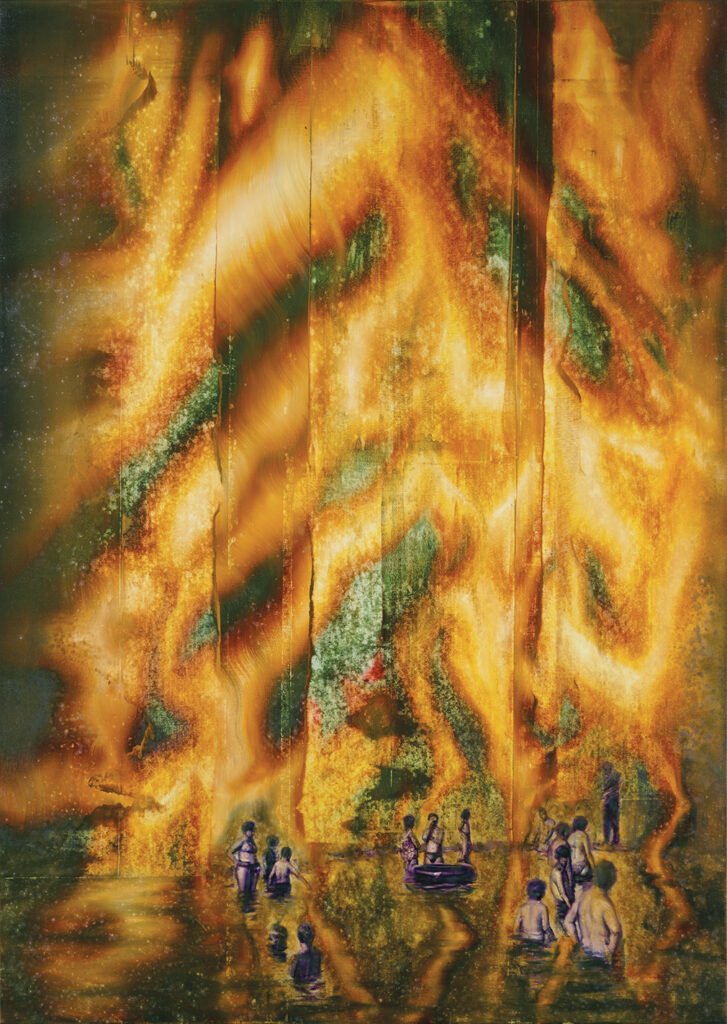
Monumentális műve, az Escape, első ránézésre egy pasztellszínekben úszó igéző tájkép. Közelebbről vizsgálva azonban inkább kísérteties, ahogy a valóságból a digitális világba – vagy éppen onnan – menekülő emberek csoportja keresi új helyét, valahol a látómezőn túl. Ez a mű, mint ahogy a kiállításon szereplő többi festmény is, titkokkal és feszültségekkel telített. Az egymással szembeforduló pisztolypár, egy zsebbe nyúló kéz, a függöny mögött várakozó és hajkorona mögé bújtatott rejtelmes nőalak, vagy a felismerhető képi elemek spontán absztrakcióba fordulása, a térből és időből kiszakított pillanatot és annak megfoghatatlanságát idézi.

Szűcs legújabb festményei egy koherens, erőteljes festői világot tárnak elénk. A festészet klasszikus nyelvén kortárs világunk legégetőbb kérdéseit feszegetik, miközben az analóg és a digitális, a jelenlét és eltűnés, az emberi és a technológiai közvetítés közötti feszültségek viszonyait vizsgálják.

Hornyik Sándor megnyitó szövege:

Hornyik Sándor:

Holografikus festészet

Szűcs Attila kiállítása a Complementary Love, avagy a Komplementer szerelem címet kapta, miközben tudjuk jól, hogy a festészetben nem annyira az érzelmek, mint inkább a színek szoktak komplementerek lenni. Ám a fizikában, pontosabban a kvantumfizikában is létezik a komplementaritás fogalma, sőt elve, ami hellyel-közzel Nobel-díjat is ért, úgy nagyjából száz éve. Niels Bohr elmélete szerint a valóság atomi, illetőleg részecskeszerű, avagy diszkrét, kvantált természete és hullámszerű értelmezése és leírása valójában nem mond ellent egymásnak, hanem kiegészíti egymást, tehát komplementer, vagyis a fény és az elektronsugár értelmezhető hullámként és részecskék sokaságaként is.

No de mit mond mindez a festészetről?

A megfogható, anyagi jellegű festék, a pigmentek és a kötőanyag számunkra elsősorban fényként, elektromágneses hullámként érzékelhető, pontosabban a látásunk, a szemünk, az idegrendszerünk, az agyunk ekként fogja fel. Viszont, ha megfogjuk és megtapintjuk, akkor érezzük a festék anyagi, materiális valóságát is, illetve az idegrendszerünk és az agyunk ekként tálalja a tapintás ingereit az elménk számára.

Fizikai és kvantumfizikai értelemben azonban valami vagy részecske, azaz diszkrét, tömör és „megfogható”, vagy pedig hullám; a hullámok interferálnak egymással, a részecskék meg nem, azok inkább ütköznek. Bohr nagy ötlete szerint itt azonban még sincs feloldhatatlan ellentmondás, mert mindez csupán attól függ, hogy hogyan, milyen eszközökkel vizsgáljuk a valóságot. A fény ugyanis értelmezhető hullámként és korpuszkulaként is kísérleti körülmények között: interferencia ábrákat produkál, de a színképek tanúsága szerint diszkrét energiájú fotonokból épül fel.

A festmény számunkra, nézők számára mégis lényegében kép, amelyet színes fény, elektromágneses hullám formájában fogadunk be. De vajon mi a helyzet a kiállítás címében szereplő szerelemmel? Miként érzékeli, dolgozza fel és hozza azt létre az elménk és az agyunk?

Van egy Komplementer szerelem című kép is a kiállításon, két fiatal csókja egy különös, absztrakt térben. Ez a festői tér amúgy maga is komplementer, hiszen komplementer színek alkotják, melyek távolról kioltják egymást, a zöldes és a rózsaszínes-pirosas tónusokból ugyanis szürke lesz, pontosabban a szemünkben lévő csapok és az elménk akként érzékelik. A pár mögött a tér maga is szürke, de a pigmentek szintjén szürke, és nagyon különleges, ami első pillantásra nem is annyira tűnik fel. Mintha egy sötét reflektor világítaná meg a szerelmeseket, vagy mintha éppen beszippantaná őket a sötétség, ha tetszik egy apró fekete lyuk. A fekete lyukak régóta inspirálják a kozmológusokat, gondoljanak csak Stephen Hawkingra, vagy újabban a Nobel-díjas Kip Thorne-ra, aki az Interstellar, magyarul a Csillagok között című Christopher Nolan film tudományos tanácsadója volt,[1] és neki köszönhetjük a filmben felbukkanó „élethű” Gargantuát, amely be is szippantja a film főhősét, aki azonban ott nem bomlik elemeire, hanem egy fura dimenziókapuban találja magát.

A fekete lyukak mostanság éppen megerősíteni látszanak egy olyan elméletet, amely Szűcs Attila világképében is meghatározó szerepet játszik. Úgy szoktak hivatkozni rá, hogy a kozmológia holografikus elve, illetőleg a kozmosz holografikus modellje. Nagyon egyszerűen arról van szó, hogy a fekete lyukak kétdimenziós eseményhorizontjának informatikai entrópia-értelmezése nem zárja ki annak lehetőségét, hogy mi, emberek egy a hologramokhoz hasonló illúzióként érzékeljük az egész univerzumot, ami valójában csak egy kétdimenziós interferencia-ábra kivetülése. Egyesek szerint a kivetülés jelenségére utal az eseményhorizontok Hawking-sugárzása, amely meglepő módon „elhagyja” az amúgy mindent elnyelő fekete lyukakat.

A holografikus illúzió kulcsa most itt persze az, hogy mi érzékeljük az univerzumot térbeli, illetve téridőbeli entitásként, éppúgy mi tesszük ezt, ahogy mi látjuk a festményeket is színes képeknek. A valóságban, a tőlünk független valóságban ugyanis nem léteznek színek, azokat csak az emberi látás apparátusa, szemünk, agyunk és elménk generálja. Éppúgy, ahogy a szeretet, illetve a szerelem érzését is... Vagy még se így áll a dolog?

Mert akkor mi is a helyzet a vallásokkal, különösen az európai panteizmussal és a pánpszichizmussal, az ázsiai buddhizmussal, vagy éppen az amerikai animizmussal, amelyek gondolatokat, érzéseket, identitást, tudatosságot tulajdonítanak a növényeknek, az állatoknak és a természeti jelenségeknek is. Mindennek létezik ráadásul egy „komoly”, tudományos, fizikai és kozmológiai megfelelője is, ami talán nem független attól sem, hogy az egyik leghíresebb múlt századi kvantumfizikus, David Bohm egy hindu filozófussal, Dzsiddu Krishnamurtival folytatott hosszú és termékeny párbeszédet a valóság valódi természetéről.

A hinduizmus tanítása szerint az általunk érzékelt valóság csupán illúzió, látszat, Májá fátyla, a lényeget, az erőket, az energiákat ugyanis nem látjuk. Bohm szerint ugyanez a helyzet adja a kvantumfizikai alapokra helyezett valóság problematikáját is. A fizikai és kvantumfizikai szempontból is koherens valóság ugyanis valójában még sokkal koherensebb, mint gondolnánk vagy képzelnénk. Bohm úgy gondolja, hogy a tőlünk független valóságban nincsnek tárgyak, de nincsenek részecskék és nincsenek hullámok se, hanem valami más van, amit mi igazából nem is tudunk érzékelni. Ezt a mélyebb valóságot nevezi ő „implicit rend”-nek, ami egy olyan pándimenzionális struktúra, amelyből – ha éppen megfigyeljük – kibomlik (unfolding) a látható és érzékelhető valóság.[2]

A Komplementer szerelem kiállítás nyitó képe két „valódi” hullám interferenciája, két klasszikus toposz alkot ugyanis egy diffúz látványt: egy függöny és egy hajzuhatag, mindkettő sztereotip jelenség, de megunhatatlan is egyben. A függöny Norman Bryson, Schopenhauer, Vermeer és Plinius, avagy Zeuxis és Parhasios festőversenye óta a festészet és az illuzionizmus allegóriája,[3] amihez a kiállítás által is megidézett figurák, Ingmar Bergman és David Lynch csak újabb jelentésrétegeket adnak, gondoljanak csak a Suttogások és sikolyokra, a Twin Peaksre, vagy a Mulholland Drive-ra. A hajzuhatag maga is allegória, de ambivalens, hiszen egyrészt a szépség klasszikus szimbóluma Vénusz lebegő hajfürtjei óta, másrészt Julia Kristeva óta a lefolyóból kikapart haj undorító jelentéstartománya is legitim része világképünknek, ahol testünk lehullott, gusztustalan részei halandóságunkra emlékeztetnek.[4] És Bohm holografikus modellje, meg Krishnamurti hindu fátyla csak újabb, komplex, ismeretelméleti rétegekkel gazdagítja e két hullámzó entitás, a függöny és a haj interferenciáját.

Szűcs Attila képei mintha éppen e fátyol, illetve e fátylak létezésének következményeit vizsgálnák a festészet eszközeivel.

Tudjuk, hogy a festmény festett vászon...

Tudjuk, hogy a filmeket valaki leforgatja...

Tudjuk, hogy mi magunk nemcsak a festményekről és a filmekről, de az azokat készítő művészekről is képet alkotunk...

De ezek a képek vajon mennyire valóságosak, mennyire koherensek? Nézzük meg például Bergman Szűcs által festett portréját: kísérteties, méghozzá a freudi értelemben: Bergman is, meg nem is... Portré is, meg nem is az... Kép is, de több is annál: teste van, festői, pasztózus anyagisága, mely kilép a két dimenzióból, széttöri az illúziót. De vajon milyen mértékben?

Ha az Univerzum maga számunkra csupán illúzióként létezik, akkor mi a helyzet az illúzióról alkotott illúziókkal? Vajon egyszer, nagyon régen Platón a barlanghasonlattal tényleg rátapintott valami nagyon lényegesre? Igen is, meg nem is... Platón ugyanis a művészeket vádolta illúziók gyártásával, a filozófusokban és a tudósokban nagyon is hitt. Ma, a teóriafikció és a posztfaktualitás korszakában kicsit már más a helyzet: végre tudjuk, hogy amit tudunk, azt mi magunk kreáljuk.

És ne legyenek illúzióik – hogy egy kedves és nemrég elhunyt tanárom kedvenc kifejezését is játékba hozzam –, szóval ne legyenek illúzióik: nemcsak az esztétika és a filozófia teóriafikcó, hanem a kozmológia és a fizika egy része is az, az oly sokaknak oly kedves 11-dimenziós húrelmélet mindenképpen. Sőt az elmefilozófia és a neuroscience is az, hiszen mindmáig nincs olyan koherens és ellentmondásmentes elmélet, amely magyarázatot adna a legkomolyabb problémára, az emberi öntudat létezésére, amely nem vezethető le fizikai, kémiai és biológiai folyamatokból.

Erről, illetve minderről is szól a Komplementer szerelem, ahol kozmikus, avagy csillagászati és részecskefizikai háttér, csillagos egek és hullámzó felületek előtt jelennek meg számunkra jól ismert, de egyre inkább széteső, dezintegrálódó vizuális toposzok, melyek azonban továbbra is meghatározzák életünket: a szerelem, a szórakozás, a fenséges, a titokzatos, a férfi és a nő...

És még ha a művészet, sőt még a valóság is csupán illúzió, ki mondja azt, hogy ne élvezzük, amíg még lehet...

A kiállítást ezennel megnyitom!


[1] Kip Thorne: Az Interstellar és a tudomány. Európa, Budapest, 2015.

[2] David Bohm: Wholeness and the Implicate Order. Routledge, London, 1980.

[3] Norman Bryson: Vision and Painting. The Logic of the Gaze. Yale University Press, New Haven, 1983.

[4] Julia Kristeva: Powers of Horror. An Essay on Abjection. Columbia University Press, 1980.


További információért kérjük keresse a galériát!


Attila Szűcs: Complementary Love

Opening: December 3, 2025, 6 PM
Opening speech by Sándor Hornyik, art historian, Doctor of the Hungarian Academy of Sciences
On view: 4 December 2025 – 30 January 2026
Open: Wednesday - Friday, 12:00 - 6:00 PM, and by appointment


The title of the exhibition—which also serves as the title of one of Szűcs’s paintings—was inspired by a letter Vincent van Gogh wrote to one of his brothers: “I am always in the hope to express the love of two lovers by a marriage of two complementary colors - colors which marry each other...” The duality of colours and visual elements, that complement each other and as well generate a vivid tension, permeates the entire exhibition. This dualism, this investigation of a mutually completing phenomena, is itself built on a paradox, since in Szűcs’s work the “complementary” simultaneously refers to harmonies that create a sense of wholeness and to the complementary colours of the visual world.

In his painting Complementary Love, an intimate kissing scene is disrupted by green and red lines that refer to the phenomenon of digital noise, turning this peaceful, idyllic moment into something that suddenly looks as though viewed through a damaged data file or a mediating technological device. As usual, the depiction of a fragmented reality and the appearance of digital glitches play significant role in Szűcs’s latest works. The figure of the Disappearing Singer or the portrait of Bergman seems to dissolve into space before blurring into pixels and disappearing into the ether. This image-glitch is not merely an aesthetic device but also symbolizes the transience of identity, memory, and presence, while Szűcs makes clear references to the world of cinema, especially to creators known for their surreal atmospheres (David Lynch, Ingmar Bergman).

His monumental work, Escape appears at first glance to be a mesmerizing landscape in pastel colours. On closer inspection, however, it seems more haunting and disturbing, as a group of people fleeing from reality into the digital world—or vice versa—confront the disintegration of the reality they once knew and search for their new place in either world. This work, like the other paintings in the exhibition, is charged with secrets and tensions. A pair of pistols turned toward one another, hands slipping something into a pocket, an enigmatic body waiting behind a curtain or hidden beneath cascading hair, and a powerfully lit handshake of figures encircled by shining stripes—all evoke unease, while conjuring a moment torn out of space and time and its inherent elusiveness.

Szűcs’s latest paintings reveal a coherent and powerful painterly universe. Using the classical language of painting, they probe some of the most pressing questions of our contemporary world, examining the relational tensions between analogue and digital, presence and disappearance, as well as the human and technological mediation.


Opening text by Sándor Hornyik:

Sándor Hornyik:

Holographic Painting

Attila Szűcs’s exhibition is titled Complementary Love, while we know well that in painting, it is usually colors, rather than emotions, that are complementary. Yet in physics, or more continually quantum physics, the concept—and indeed the principle—of complementarity also exists, something that was essentially worth a Nobel Prize some hundred years ago. According to Niels Bohr’s theory, the atomic, or particle-like—that is, discrete and quantized—nature of reality and its wave-like interpretation and description do not actually contradict one another; rather, they complete each other. They are, therefore, complementary: light and electron beams can be interpreted both as waves and as a multitude of particles.

But what does all this say about painting?

The tangible, material nature of paint, pigments, and the binding medium is perceived by us primarily as light, as electromagnetic waves; or more precisely, our vision, our eyes, our nervous system, and our brain grasp it as such. However, if we touch and feel it, we sense the material, physical reality of the paint as well, or rather, our nervous system and brain present the stimuli of touch to our mind in this manner.

In a physical and quantum physical sense, however, something is either a particle—that is, discrete, solid, and "tangible"—or it is a wave. Waves interfere with one another; particles do not—they tend to collide. Yet according to Bohr’s great insight, there is still no irresolvable contradiction here, because it all depends merely on how, and with what tools, we examine reality. For light can be interpreted as both a wave and a corpuscle under experimental conditions: it produces interference patterns, yet according to the evidence of spectra, it is built up of photons of discrete energy.

Nevertheless, for us viewers, a painting is essentially an image that we receive in the form of colored light, of electromagnetic waves. But what of the "love" mentioned in the exhibition’s title? How does our mind and brain perceive, process, and create it?

There is indeed a painting titled Complementary Love in the exhibition: the kiss of two young people in a strange, abstract space. This painterly space is itself complementary, as it is composed of complementary colors which extinguish each other from a distance; the greenish and pinkish-red tones become gray—or more precisely, the cones in our eyes and our minds perceive them as such. The space behind the couple is itself gray, but it is gray at the level of pigments, and very peculiar, which does not appear so striking at first glance. It is as if a dark spotlight were illuminating the lovers, or as if darkness were sucking them in—a tiny black hole, if you will. Black holes have long inspired cosmologists—think only of Stephen Hawking, or more recently the Nobel laureate Kip Thorne, who was the scientific advisor for Christopher Nolan’s film Interstellar[1], and to whom we owe the "lifelike" Gargantua appearing in the film, which indeed sucks in the protagonist, who does not, however, disintegrate into his elements there, but finds himself in a strange dimensional gateway.

Black holes nowadays seem to be confirming a theory that plays a decisive role in Attila Szűcs’s worldview as well. It is usually referred to as the holographic principle of cosmology, or the holographic model of the cosmos. Put very simply, the informational entropy interpretation of the two-dimensional event horizon of black holes does not exclude the possibility that we humans perceive the entire universe as an illusion similar to holograms, which is in reality merely the projection of a two-dimensional interference pattern. According to some, the Hawking radiation of event horizons, which surprisingly "leaves" the otherwise all-absorbing black holes, points to the phenomenon of projection.

The key to the holographic illusion here is, of course, that we perceive the universe as a spatial or spatiotemporal entity; we do this just as we see paintings as colored images. In reality, in the reality independent of us, colors do not exist; they are generated only by the apparatus of human vision: our eyes, our brain, and our mind. Just as the feeling of affection or love is generated... Or is that not how it works?

For then, what is the situation with religions, particularly European pantheism and panpsychism, Asian Buddhism, or even American animism, which attribute thoughts, feelings, identity, and consciousness to plants, animals, and natural phenomena as well? Moreover, there exists a "serious," scientific, physical, and cosmological equivalent to all this, which is perhaps not unrelated to the fact that one of the most famous quantum physicists of the last century, David Bohm, conducted a long and fruitful dialogue with a Hindu philosopher, Jiddu Krishnamurti, about the true nature of reality.

According to the teachings of Hinduism, the reality we perceive is merely an illusion, a semblance, the Veil of Maya; we do not see the essence, the forces, the energies. According to Bohm, this same situation presents the problematic nature of reality placed on quantum physical foundations. Reality, coherent from both a physical and quantum physical perspective, is actually far more coherent than we would think or imagine. Bohm believes that in the reality independent of us, there are no objects, no particles, and no waves either, but rather something else exists which we cannot truly perceive. He calls this deeper reality the "implicate order," a pandimensional structure from which—if we happen to observe it—the visible and perceptible reality unfolds.[2]

The opening image of the Complementary Love exhibition is the interference of two "real" waves; two classical topoi create a diffuse spectacle: a curtain and a cascade of hair. Both are stereotypical phenomena, yet unboring all the same. Since the painting contest of Zeuxis and Parrhasius, and through Norman Bryson, Schopenhauer, Vermeer, and Pliny, the curtain has been an allegory for painting and illusionism[3], to which the figures evoked by the exhibition—Ingmar Bergman and David Lynch—add only newer layers of meaning; think only of Cries and Whispers, Twin Peaks, or Mulholland Drive. The cascade of hair is itself an allegory, but an ambivalent one: on the one hand, it is the classic symbol of beauty since Venus’s floating locks; on the other hand, since Julia Kristeva, the repulsive meaning-range of hair clawed from the drain is also a legitimate part of our worldview, where the fallen, disgusting parts of our body remind us of our mortality.[4]

And Bohm’s holographic model, along with Krishnamurti’s Hindu veil, enriches the interference of these two waving entities—the curtain and the hair—with newer, complex, epistemological layers.

Attila Szűcs’s images seem to examine precisely the consequences of the existence of this veil, or these veils, through the tools of painting.

We know that a painting is painted canvas...

We know that films are shot by someone...

We know that we create an image not only of the paintings and films but of the artists making them as well...

But how real, how coherent are these images? Let us look, for example, at the portrait of Bergman painted by Szűcs: it is ghostly, specifically in the Freudian sense: it is Bergman, and yet it is not... It is a portrait, yet not one... It is an image, but more than that: it has a body, a painterly, impasto materiality which steps out of the two dimensions, shattering the illusion. But to what extent?

If the Universe itself exists for us merely as an illusion, then what of the illusions formed about illusion? Did Plato, once, a long time ago, truly put his finger on something very essential with the Allegory of the Cave? Yes and no... For Plato accused artists of manufacturing illusions, while he believed very much in philosophers and scientists. Today, in the era of theory-fiction and post-factuality, the situation is slightly different: we finally know that what we know is what we create ourselves.

And make no mistake—to bring into play a favorite phrase of a dear and recently deceased professor of mine—so, make no mistake: not only are aesthetics and philosophy theory-fiction, but a part of cosmology and physics is too; the 11-dimensional string theory, so dear to so many, certainly is. Moreover, philosophy of mind and neuroscience are as well, since to this day there is no coherent and non-contradictory theory that would explain the most serious problem: the existence of human self-consciousness, which cannot be derived from physical, chemical, and biological processes.

It is about this, and indeed all of this, that Complementary Love speaks, where cosmic, or astronomical and particle physics backgrounds, starry skies, and undulating surfaces serve as the backdrop for the appearance of visual topoi well known to us, yet increasingly falling apart and disintegrating, which nonetheless continue to define our lives: love, entertainment, the sublime, the mysterious, man and woman...

And even if art, and even reality, is merely an illusion, who says we shouldn't enjoy it while we can...

I hereby declare the exhibition open!

[1] Kip Thorne: The Science of Interstellar. W. W. Norton & Company, 2014.

[2] David Bohm: Wholeness and the Implicate Order. Routledge, London, 1980.

[3] Norman Bryson: Vision and Painting. The Logic of the Gaze. Yale University Press, New Haven, 1983.

[4] Julia Kristeva: Powers of Horror. An Essay on Abjection. Columbia University Press, 1980.


For more information, please contact the gallery.